
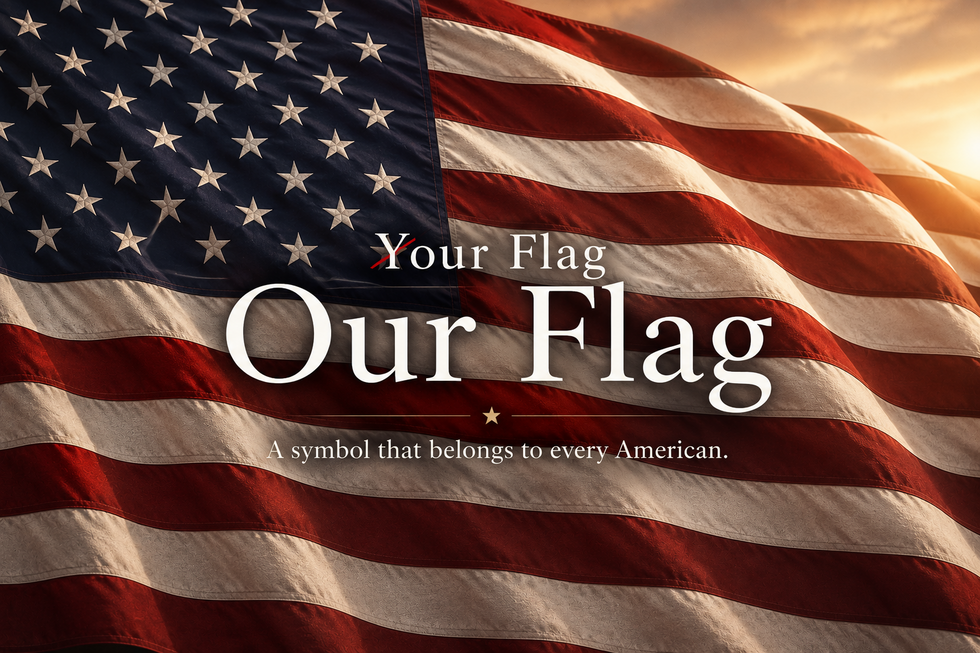
The American flag has always been more than a piece of fabric. It is a symbol of shared ideals, constitutional principles, sacrifice, and hope. Yet in recent years, many Americans have come to associate the flag with a particular political movement or ideology. Whether that perception is accurate or not, the result has been unfortunate: a national symbol intended to unite has increasingly become viewed by some as a marker of political identity.
It doesn't have to be that way. The Stars and Stripes belong to all Americans—not to any political party, movement, or ideology. It flies over courthouses, schools, national parks, military cemeteries, and polling places. It is carried by veterans returning home, immigrants taking the Oath of Citizenship, first responders serving their communities, and families celebrating holidays together. The flag represents a nation built on the enduring promise that people with differing beliefs can live under a common Constitution and resolve their differences through the rule of law.
That principle is especially important today. One of the great strengths of the United States has always been its ability to accommodate disagreement without abandoning shared commitments. Americans have debated the meaning of liberty, equality, justice, and opportunity since the nation's founding. Those debates have often been difficult, and at times painful. Yet throughout our history, the flag has served as a reminder that our common identity is larger than our disagreements.
The Constitution itself anticipates disagreement. It protects freedom of speech, freedom of religion, freedom of the press, and the right to assemble precisely because reasonable people will see the world differently. Our legal system is founded on the belief that competing viewpoints should be heard, tested, and resolved through democratic institutions rather than force or intimidation.
As a lawyer, I see every day that respect for the rule of law depends upon recognizing the equal dignity of every person. The justice system functions because we accept that rights belong to everyone—not only to those with whom we agree. In much the same way, our national symbols belong to everyone, regardless of political affiliation. Allowing any one group to claim exclusive ownership of the American flag diminishes what the flag represents. It transforms a shared symbol into a partisan one, narrowing rather than expanding its meaning.
But the flag's history tells a different story. It has flown over moments of remarkable progress and moments of profound challenge. It has been carried by soldiers defending the nation abroad and by citizens advocating for greater justice at home. It has appeared at civil rights marches, naturalization ceremonies, community service projects, disaster relief efforts, and countless acts of quiet patriotism that never make headlines. These stories are not contradictory. They are part of the same American tradition.
Patriotism has never required uniformity of opinion. In fact, one of the most patriotic acts in a constitutional democracy is participating thoughtfully in civic life—voting, volunteering, serving on juries, engaging respectfully with neighbors, and working to improve our communities. Loving one's country does not require believing it is perfect. It requires believing it is worth preserving and improving.
For that reason, perhaps it is time to reclaim a simple idea: the American flag is our flag. Not your flag. Not my flag. Our flag.
That small shift in perspective carries an important message. It reminds us that our shared citizenship precedes our political differences. It encourages us to view one another not first as opponents, but as fellow Americans who inherit the same constitutional traditions and share responsibility for the nation's future.
This does not mean abandoning deeply held beliefs or avoiding difficult conversations. Healthy democracies depend on vigorous debate. But those debates become more productive when they begin from a foundation of mutual respect and a recognition that we are participants in the same constitutional project.
At its best, the American flag represents that shared endeavor. It stands for the freedoms protected by the Constitution, the responsibilities of citizenship, and the ongoing work of building a more just society. Those ideals are not the property of any party or ideology. They belong equally to every American.
Perhaps the next time you see the flag, it can serve as an invitation rather than a declaration—an invitation to remember that while we may disagree about many things, we remain connected by a common commitment to liberty, justice, and the rule of law. That commitment is something worth protecting together.
Because the Constitution belongs to every American. The promise of liberty belongs to every American.


Comments
There are no comments for this post. Be the first and Add your Comment below.
Leave a Comment